
Yves Tanguy, 1900 – 1955
January 5, 2012
January 5
Yves Tanguy was a self-taught artist who lived and worked in the center of the Surrealist Movement in Paris. The area he focused most of his efforts in exploring was “automatism,” which meant:
“Automatism in the visual arts can arise from manual techniques that involve chance in the creation of the work ( frottage, grattage, decalcomania) or from psychological experiences (hallucination, intoxication, hypnotic trance, dream narration),” (Jennifer Gibson, see below).
Tanguy very rarely used preliminary sketches, and prefered to paint “in the moment.” He is sometimes considered to be the higher end, more intellectual surrealist than Dali; and he certainly was more subtle in his work. Tanguy married the American Surrealist Kay Sage in 1940, and became an American citizen in 1948. The work he first created after coming to America is most often characterised as gaudy – with flashy colors. For better or for worse, he moved back to his more somber color palette, and his final works are considered “funereal,” although that characterization may be in part because he died of a cerebral hemorrhage shortly after painting them.
Gibson, Jennifer. “Automatism.” Grove Art Online. Oxford Art Online. 4 Jan. 2012 <http://www.oxfordartonline.com/subscriber/article/grove/art/T005221>.
Masters, Christopher. “Tanguy, Yves.” The Oxford Companion to Western Art. Ed. Hugh Brigstocke. Oxford Art Online. 4 Jan. 2012 http://www.oxfordartonline.com/subscriber/article/opr/t118/e2563.
Pierre, José. “Tanguy, Yves.” Grove Art Online. Oxford Art Online. 4 Jan. 2012 <http://www.oxfordartonline.com/subscriber/article/grove/art/T083251>.
Alfred Stieglitz, 1864 – 1946
January 1, 2012
January 1
All of the images from this slide show are from http://www.metmuseum.org/toah/hd/stgp/hd_stgp.htm.
Alfred Stieglitz was one of the most powerful men in American modern art in the twentieth century, and also one of the hardest to know. I read in a biography of Georgia O’Keeffe that she struggled with her role in art – as either an artist or as a model. Alfred Stieglitz balanced the role of an artist with the role of art dealer, and history changer.
As a photographer, Stieglitz explored what was then a fairly new technology. He used handheld cameras to capture life during the early 1900s, most famously with this picture called The Steerage (1907), that showed how the different classes traveled on ships. He did portraits, many of them of Georgia O’Keeffe. He took pictures of every part of her, in addition to formal portraits. As a collection, it is probably the most intimate portrait of a person taken to date.
Stieglitz owned the gallery 291, which was where a number of American artist’s careers were made, most well known being Georgia O’Keeffe. Marsden Hartley and Charles Demuth were also featured, and sold by Stieglitz. He knew the importance of his role as a dealer, and would vet the buyers to make sure that the artwork he was selling ended up in important collections, which would then increase the value of his artists.
Camera Notes and Camera Work were two publications that Stieglitz edited that helped to change the role of photography in the art world. He helped to make people, the important ones that decide what is “High Art,” see the value of photography. He helped to bring this art form to the mainstream art world, and the art world’s focus shift from Paris to New York.
On a personal front, Stieglitz was by all accounts very difficult to live with. His daughter ended up in a psychiatric hospital, he left his first wife for Georgia O’Keeffe, and O’Keeffe was able to stay with him by spending half the year in the Southwest. So, I guess we can inadvertently credit him with inspiring some of O’Keeffe’s finest and most successful work.
Davide Teniers the Younger, 1610-1690
December 15, 2011

- The Archduke Leopold William in his Picture Gallery in Brussels
baptized December 15, 1610
When I was working on my curriculum to teach AP Art History, a friend of mine took the art history textbook I was working from and showed me the hundred pages or so of, “Art that people actually care about.” Paintings about the peasants or court life from the 1600s didn’t make her cut. But art historians LOVE this stuff. Just google, “David Teniers the Younger,” if you don’t believe me.
So… why? Artists like David Teniers the Younger were historians. In his case, he literally documented paintings for archduke Leopold Willam, making smaller versions of his art collection, which were then engraved and published as a book. In addition, he painted “real life.” What did a gathering of regular people look like in the mid-1600s?

- A County Festival Near Antwerp
There you go. Now, historians know when they collect the objects of the famous that the minutia is important and will tell you something of the time that the person lived in. But in the 1600s no one was saving the detritus of the regular people so much of the information we have about them comes from genre paintings, of which David Teniers the Younger was a master.
For more information, google him, or go to http://www.nationalgallery.org.uk/artists/david-teniers-the-younger, and http://www.britannica.com/EBchecked/topic/587269/David-Teniers-the-Younger.
Auguste Rodin, 1840-1917
November 12, 2011

Many of Rodin’s sculptures as we know them were made to to be a part of his Gates of Hell.
November 12
One of the things that Auguste Rodin was best at was ignoring rejection. The Ecole the Beaux-Arts, THE art school in France, which was THE place to go to art school, rejected him three times. He was rejected from, after being drafted to, the National Guard for near-sightedness. His first major sculpture was rejected because people thought it was cast from a live person.
In spite of those set backs, Rodin kept working. He was given a commission to create an entry to a future decorative arts museum. Rodin began the Gates of Hell, based on Dante’s Divine Comedy, in 1880 and continued working on it for the rest of his life. This larger, ultimately unfinished project, produced several of his most famous works – The Thinker, and The Kiss.

The Kiss, 1901, The Tate, London
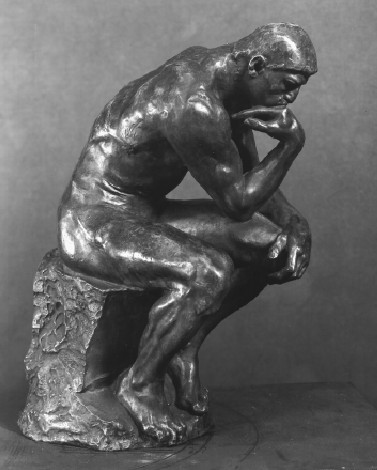
The Thinker, 1902, National Gallery of Art, Washington, DC
Links to what I was reading:
- http://www.rodinmuseum.org/286-97.html – The Rodin Museum in Philadelphia, PA
- http://www.musee-rodin.fr/en/ – The Rodin Museum in Paris, France
- http://www.cantorfoundation.org/Rodin/rbioe.html – a very thorough biography
- http://www.biography.com/people/auguste-rodin-9461735 – very mainstream biography
Charles Demuth, 1883 – 1935
November 8, 2011
November 8.
In doing some of the back story for Charles Demuth, I discovered that he was one of the first people in America to receive insulin injections for his diabetes, an illness that affected him all of his adult life, and resulted in his death. But that isn’t what his life should focus on for the purpose of this blog.
Demuth spent most of his life in and around Lancaster, Pennsylvania (pronounced by persnickety Pennsylvania natives as LANK-aster – not the British version). He refined his work in Paris, France but became famous through being one of the artists that was a part of Steiglitz’s circle (the most famous member being Georgia O’Keeffe, and it also included Marsden Hartley).
In the process of figuring out how to create his work, Demuth started to create portraits of people using symbols. He called them posters, and in at least one letter to Alfred Stieglitz he said that they were personal, and for his own enjoyment. Many art scholars feel that he created portraits based on symbols to express his feelings about people or things, without sharing his own personal history with that person because he was gay. The most famous of his symbol-focused works is probably his most famous piece, called The Figure Five In Gold (1928), which was created in response to the poem below.
The Great Figure
by William Carlos Williams (1883-1963)
Among the rain
and lights
I saw the figure 5
in gold
on a red
fire truck
moving
tense
unheeded
to gong clangs
siren howls
and wheels rumbling
through the dark city
[from Sour Grapes: A Book of Poems (1921)]
I snitched the poem, and the forthcoming reference from another blog about Demuth’s “movement”: “Precisionism was an artistic movement that emerged in the United States after World War I and was at its height during the inter-War period. The term itself was first coined in the early 1920s. Influenced strongly by Cubism and Futurism, its main themes included industrialization and the modernization of the American landscape, which were depicted in precise, sharply defined, geometrical forms.” [Wikipedia]
For Demuth’s human voice, including the letter where he talks about the posters, see amazon.com for Letters of Charles Demuth, American artists, 1883-1935 by Charles Demuth, Bruce Kellner, Demuth Foundation. The Demuth Museum, located in Lancaster, has a website at www.demuth.org.
Francis Bacon, 1909 – 1992
October 28, 2011
 With the exception of this introduction, this post is entirely sourced, and/or quoted from http://www.francis-bacon.com/, an incredibly respectful and complete tribute to the artist – and I can’t help noting that it is SO tidy compared to everything I have ever read or heard about the artist. Reading descriptions of the walls of Francis Bacon’s studio – which he used as a palette for YEARS – he was so real, and so earthy, and it was true to his work, and the way he lived. Bacon’s studio is not just fascinating to me – after his death, it went on to be installed in a museum: http://news.bbc.co.uk/2/hi/entertainment/1345486.stm. I have always admired the chaos of his life in his work; he is such a mix of wonderful eccentricities. What follows is a highlight’s reel from the biography section of his estate website:
- “Francis Bacon was born in a nursing home.”
- His parents were British, but moved to Ireland because of money problems.
- “Bacon’s only prolonged experience of formal schooling was as at the Dean Close School, Cheltenham, where he boarded from the autumn of 1924 to the spring of 1926.”
- “His father was a belligerent and argumentative…his mother, a gregarious hostess inclined to self-absorption.”
- Francis had chronic asthma, which I only find interesting because of the descriptions of copious amounts of dust in his studio.
- “Bacon’s emerging homosexuality severely strained relations with his family and, by his own account, he was expelled from the household in 1926.” (age 16)
- on Berlin, “he savored its opulence, experienced at first hand in the Hotel Adlon, and its squalor, felt in the poverty of the surrounding streets.”
- Bacon, in his travels, discovered, “Nicholas Poussin’s painting, The Massacre of the Innocents, c.1630, Château de Chantilly (Musée Condé), and its portrayal of a screaming mother trying to protect her infant. In Bacon’s mind it was ‘probably the best human cry ever painted’, a precocious sign of his obsession with a single image by another artist.”
- “Bacon seems to have considered becoming an artist only after attending an exhibition of drawings by Picasso at the Galerie Paul Rosenberg in the summer of 1927.”
- Returning to London in 1928, “Bacon became an interior decorator and furniture designer.”
- (1932) “Over the next twenty years he shared various living quarters with his old nanny Jessie Lightfoot, who could also be light with her fingers when either or both their funds ran short.”
- “In the summer of 1936 his work was rejected by the International Surrealist Exhibition in London on the grounds that it was insufficiently surreal.”
- Bacon practiced, “a pattern of ruthless self-editing that he pursued for most of his life, but particularly so during his early years.” – he destroyed the artwork he didn’t like.
- “Bacon’s asthma meant that he was pronounced unfit for active service in the Second World War.”
- “His experience of treading among the ruins of bombsites seems to have prompted a more concentrated and visceral imagery.”
- “In late 1943 Bacon moved into the ground floor of …a house once owned by the Pre-Raphaelite painter, John Everett Millais. Its cavernous moth-eaten grandeur provided an appropriate backdrop for an illicit casino run by Bacon and Lightfoot.”
- “It began as an attempt to paint a bird alighting on a field and ended as an assemblage of meat carcasses and a mutilated, almost headless man beneath an umbrella.”
- “Within weeks of selling Painting, 1946, Bacon was on his way to Monte Carlo. There he gambled recklessly and sometimes with considerable success.”
- “The works were simpler, reduced with one exception to a single figure and far more focused in expression, dwelling on significant and disturbing details such as open mouths, teeth, ears and safety pins.”
- “His subsequent works departed from it in one vital respect; they were painted on the unprimed or ‘wrong’ side of the canvas rather than on hardboard. Bacon began working in this way while still in Monte Carlo. He had used up all his primed canvases and decided, perhaps out of desperation, to take one off its stretcher and try working on the other side. He found the raw canvas held the paint with more bite, enhanced its texture and allowed thinner applications to soak into the canvas. The indelibility of each mark raised the stakes, the medium’s intractability posed a rewarding challenge, and Bacon found a technique precisely attuned to his temperament. He continued painting on the unprimed side, though the reverse was always primed, till the end of his life.”
- Bacon painted many, many, many, many variations of Velázquez’s Portrait of Pope Innocent X, 1650, “His experience of the Velázquez was entirely by way of reproductions, a dependency that, far from limiting the artist, encouraged him to take extravagant licence.”
- “Eadweard Muybridge’s, The Human Figure in Motion became an indispensable visual dictionary for Bacon.”
- (1954) “When in Rome… he deliberately avoided seeing Velázquez’s Pope Innocent X in the flesh.”
- To make deadlines: “Bacon’s application of paint became coarser, his impasto thick and ridged, and his colours far more strident in range and hue.”
- (1961) “The first floor studio was to be the most important room in the artist’s life. Over the years it became an overwhelmingly cluttered space with vibrant daubs and accretions of paint on the walls and doors. Its layers of dust, debris and toxic pigments could only have exacerbated his chronic asthma and its East-West orientation was never ideal. In later life, despite occasionally acquiring new and more spacious places to work, he always returned to this awkward but familiar room. The studio became Bacon’s complete visual world. Its heaps of torn photographs, fragments of illustrations and artist’s catalogues provided nearly all of his visual sources. He had all but given up painting from life.”
- “He readily admitted that it was painted during an unusually booze-fueled fortnight, a working method that rarely delivered results, but in this case liberated him.”
- “Towards the end of 1963 a new man entered Bacon’s life. George Dyer was a dapper Eastender with a petty criminal past and a tough look that belied a depressive and insecure nature.”
- “Photography, itself, became an indispensable means to Bacon’s expressive ends… allowed the artist to capture the vitality of his subjects while keeping a critical distance. He would twist their features and practice his ‘injuries’ without having to contend with the judgement of the sitter (a problem he encountered at least once in the 1950s).”
- “In his public utterances, Bacon placed heavy emphasis on the role of chance and accident in his work and denied using preparatory drawings. On the latter point, he was certainly misleading.”
- (1992) “On the 28th of April, he suffered a heart attack and died in the presence of two nuns from the Servants of Mary. Bacon was trenchant in his atheism but there is no evidence that he resisted the care of the religious.”
- “In the Reece Mews studio, a final portrait stood incomplete on a tall easel. It had been there since the previous November where it was observed by his only surviving sister, Ianthe. The identity of its subject, the assertive profile caught half way between a self-portrait and a portrait of George Dyer, has so far defied resolution.”
Pablo Picasso, 1881-1973
October 25, 2011
 Pablo Picasso was a man with a creative and brilliant mind with an ego that just wouldn’t quit. He had such a huge presence, I am not entirely sure it is appropriate to use the past tense when speaking about him.
While twentieth century art is known for its multiple movements: Minimalism, Abstract Expressionism, Bauhaus, etc. – Picasso was so big – he had his own movements, starting with his Blue Period, a several year period of works done after a close friend died that feature a cool, blue palette and beautiful and depressing subject matter. Following that, the Rose period, which was inspired by the saltimbanques, Spanish circus people – I have always seen the American equivalent being the “carny.”
Picasso, and fellow artist Georges Braque, started the first major twentieth century art movement, Cubism, which is all about breaking a realistic image on a flat surface so that you can see multiple views at once. So if you have a newspaper on a table with a guitar, you might see both the top and side of the table, the folded side of the newspaper, as well as the headline, and several angles of the guitar. Music and musicians often look particularly appropriate when broken up in a cubist way. No matter what Picasso was painting from then on – there is almost always something… askew.
Classicism comes next, which is a name for a time period where Picasso created a bunch of paintings with giant, bulbous people with proportionally small heads, usually in very classical (toga-like) outfits.
Picasso painted his best known work, Guernica, during the Spanish Civil War to protest the decimation of a small Spanish town by Spanish fascist troops supported by a new pre-WWII German war machine. The painting is a huge wall mural (it was painted to fill a wall at the Spanish Tent in a World’s Fair), and Picasso uses an abbreviated style of line to show emotional and skewed images reflecting the decimation war causes. The imagery for Picasso – includes Spanish symbolism, but because it is symbolic the painting has become a universal symbol of the evils of war, and the importance of shining a light on the evil (to take action against it).
After WWII, Picasso created work that I would categorize the “Picasso Period.” Historians and critics alike have a mix of things to say about his work – some even accusing the man of… cough… “selling out,” as though his production of hundreds of works of painting, sculpture, and pottery was so excessive that quality was sacrificed (visiting the Picasso Museum in Paris, I calculated based on the data that was given by the museum, that he was producing something like 20 pieces of pottery a day – before you add the paintings, sculptures, and dalliances with ladies…). He created a LOT of work. Some of it was fabulous, and some… was just – hopefully – signed “Picasso!”
For a great movie that includes stories about the authenticity of Picasso’s work, check out Orson Welles’ F for Fake. FABULOUS.
Any writing celebrating the work of Picasso needs to make some mention of the women who sacrificed their, well usually sanity was the first to go, to help him keep his mojo. A list of eight of his major ladies and the story of their often overlapping relationships with Spain’s greatest bull is at http://sapergalleries.com/PicassoWomen.html.
In 2006, an art teacher in Germantown, Maryland proclaimed October 25th as Picasso Day in order to have a day to make a point of addressing who Picasso was with students who know the computer program Picassa better than the artist it was named after. With knowledge, fewer students will believe that Picasso painted the Mona Lisa. Picasso Day is celebrated with cards, Picasso-themed hats, handmade pins, parties, and the motto, “Why be a square, when you can be a CUBEist?”
A good resource with pictoral examples:
http://www.arthistoryarchive.com/arthistory/cubism/Pablo-Picasso.html
Faith Ringgold
October 8, 2011

Dancing at the Louvre, by Faith Ringgold
Faith Ringgold biography
SYNOPSIS
Faith Ringgold was born October 8, 1930, in New York, New York. In 1963 she began a body of paintings called the American People series, which portrays the civil rights movement from a female perspective. In the 1970s she created African-style masks, painted political posters, lectured frequently at feminist art conferences, and actively sought the racial integration of the New York art world.
PROFILE
(born Oct. 8, 1930, New York, N.Y., U.S.) American artist and author who became famous for innovative, quilted narrations that communicate her political beliefs.
Ringgold grew up in New York City’s Harlem, and while still in high school she decided to be an artist. She attended City College of New York, where she received B.S. (1955) and M.A. (1959) degrees. In the mid-1950s she began teaching art in New York public schools. By the 1960s her work had matured, reflecting her burgeoning political consciousness, study of African arts and history, and appreciation for the freedom of form used by her young students.
In 1963 Ringgold began a body of paintings called the American People series, which portrays the civil rights m ovement from a female perspective. In the 1970s she created African-style masks, painted political posters, lectured frequently at feminist art conferences, and actively sought the racial integration of the New York art world. She originated a demonstration against the Whitney Museum of American Art and helped win admission for black artists to the exhibit schedule at the Museum of Modern Art. In 1970 she cofounded, with one of her daughters, the advocacy group Women Students and Artists for Black Art Liberation.
Among Ringgold’s most renowned works, her “story quilts” were inspired by the Tibetan tankas (paintings framed in cloth) that she viewed on a visit to museums in Amsterdam. She painted these quilts with narrative images and original stories set in the context of African American history. Her mother frequently collaborated with her on these. Examples of this work includes Who’s Afraid of Aunt Jemima? (1984), Sonny’s Quilt (1986), and Tar Beach (1988), which Ringgold adapted into a children’s book in 1991. The latter book, which was named Caldecott Honor Book in 1992, tells of a young black girl in New York City who dreams about flying. Ringgold’s later books for children include Aunt Harriet’s Underground Railroad in the Sky (1992) and My Dream of Martin Luther King (1995). Her memoirs, We Flew over the Bridge, were published in 1995.
Copyright © 1994-2011 Encyclopædia Britannica, Inc. For more information visit Britannica.com
Citation: ” Faith Ringgold.” 2011. Biography.com 06 Oct 2011, 09:19 http://www.biography.com/people/faith-ringgold-9459066
The artist’s website: http://www.faithringgold.com/ringgold/default.htm
Jean-Louis André Théodore Géricault, 1791-1824
September 26, 2011
 The painting above is called The Raft of the Medusa and is the most well known work of artist Théodore Géricault. He also painted horses, because of his love of riding. He later also did a number of portraits of the insane. The Louvre (the link is in the list below), explained the painting, and the story behind it this way:
Romanticism’s manifesto, this work caused a huge scandal at the Salon of 1819. For the first time, an artist had depicted an event from contemporary history without having received a commission and had filled his composition with anonymous figures in a format hitherto reserved for historical painting. Precursor of the critical spirit that so often motivates art today, the subject was a caustic statement on the government then in power: in 1816, the frigate “Medusa” sank because of the incompetence of a captain who had obtained his post through political relations. Due to a shortage of lifeboats, 149 people piled onto a raft that drifted for twelve days. Only fifteen survived the ensuing slaughter, madness, and cannibalism. Seen from one corner, the raft appears very unstable, while two diagonals heighten the dramatic tension: one leads the eye to the vast wave that threatens to engulf the raft, the other leads to the tiny silhouette of “The Argus,” the ship that eventually rescued them. This long oblique line evokes the tragedy — the torso of a man who has perhaps been devoured by his companions — and the various psychological states of mind: the dejection of the bewildered man holding his dead son, the dying man rising up with a start, and the desperate hope of those waving to their potential rescuer. But at this point in time, nobody knew which way the scales of fortune would tip. The only hero in this poignant story is humanity, and that is what still moves us today.
Théodore Géricault died at the age of 32 due to disease and injuries sustained from horse riding.
- http://www.bookrags.com/biography/jean-louis-andre-theodore-gericault/
- http://www.britannica.com/EBchecked/topic/230550/Theodore-Gericault
- http://www.louvre.fr/llv/activite/detail_parcours.jsp?CURRENT_LLV_PARCOURS%3C%3Ecnt_id=10134198673226914&CONTENT%3C%3Ecnt_id=10134198673327664&CURRENT_LLV_CHEMINEMENT%3C%3Ecnt_id=10134198673327664&bmLocale=en


Written
on January 30, 2012